Calling It In: Intent Doesn’t Excuse Antisemitism or Islamophobia
When “I Didn’t Mean It” Isn’t Enough

A teenager wearing an article of their faith pauses at the edge of a quad and pretends to tie a shoe so she can scan the faces around her. A grandmother counts to three before stepping through the synagogue door. A father lingers outside a mosque, phone to his ear, measuring the street. None of them cares what someone “meant.” They care whether it’s safe because for far too long, for them, it simply hasn’t been.
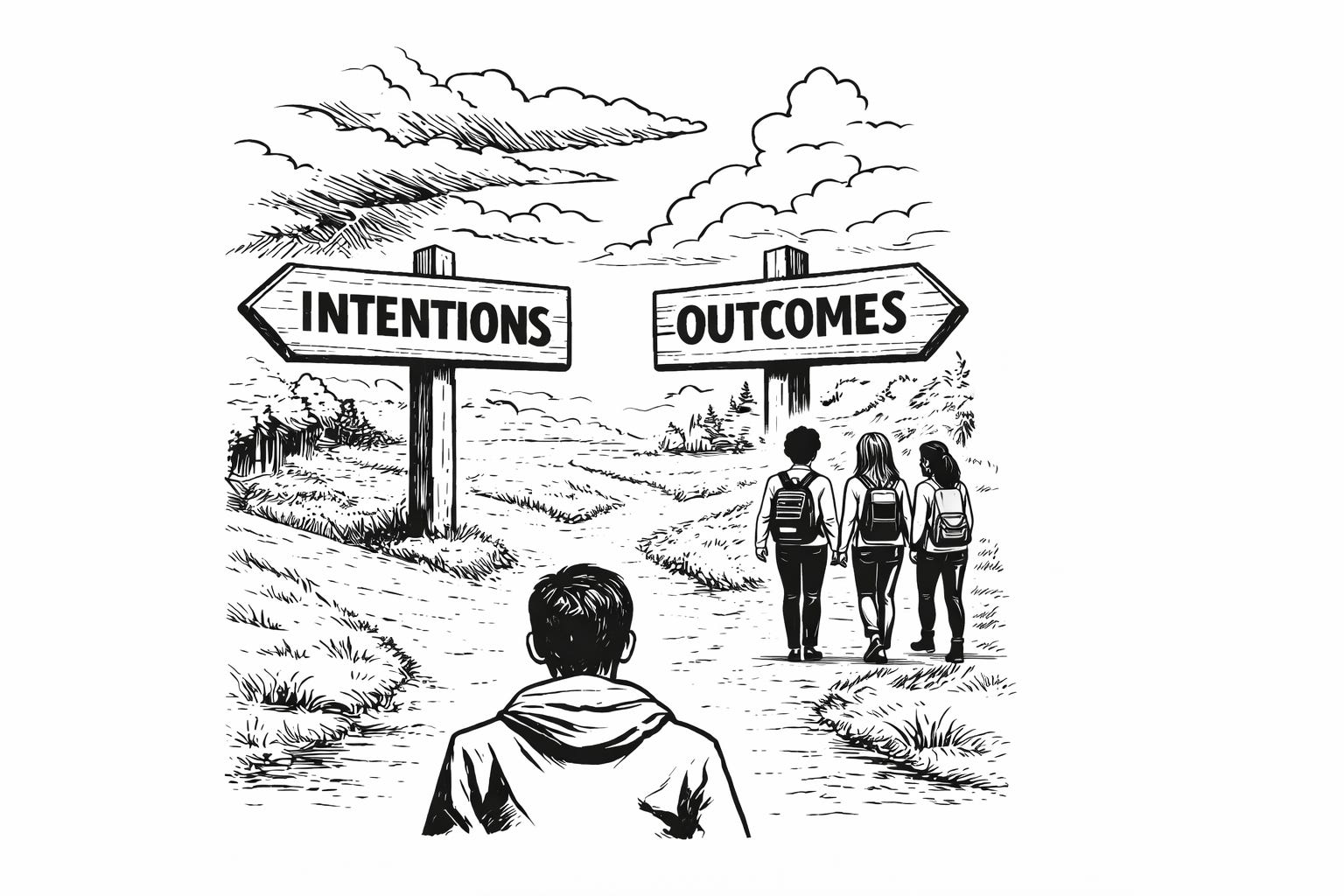
For 250 years, this country has been learning, too slowly and often painfully, what bias does to real people: racism, antisemitism, Islamophobia, sexism, ageism, homophobia, transphobia and other forms of bias lead to violence and alienation. While individual experiences of harm vary, antisemitism, Islamophobia and other forms of bias are not abstract or idiosyncratic. They follow recognizable patterns that communities name again and again. I am not shaming us for having to learn, I am asking us to use one of the best tools we have built so far. Since 1987, I’ve been part of America’s civil rights movement and one rule I’ve learned from generational elders has never wavered: judge by outcome and measure actions, choices and decisions by what they do. Within the civil rights movement, Outcome is often defined by what the action does to people’s safety, dignity, or access. Intent is what the actor meant. Intent never decides whether harm happened. Outcome decides whether harm occurred. Intent helps us understand a person’s values and openness to accountability, but it does not undo the harm experienced. That’s it. No loopholes.
How do you tell policy and political critique from group harm? The choices tell the truth. Critique aims at decision makers, not a whole people. Reach for facts, not old stereotypes about cabals, dual loyalty, global control, or “Trojan horses.” Political critique uses accountable tactics, not doxxing lists, mobbing, vandalism, shunning or loyalty tests that chill belonging and full participation. Critique uses neutral timing, not holy days, it protests without targeting Jewish or Muslim spaces in ways in which the outcome heightens community fear.
Lately, this is where some still try to carve an exception, “I am criticizing Israel or Zionism, not Jews.” “I am criticizing extremism, not Muslims.” Yet we do not accept that logic anywhere else. “We are preventing theft,” while shadowing only Black and Latino teens, is profiling. “I meant it as a compliment,” after commenting on a woman’s body at work, is harassment. Same rule here: when tactics and behaviors land on Jews as Jews or Muslims as Muslims, that is bias. We stop it and correct it.
When our choice points stack the wrong way, we are no longer arguing policy or politics, we are landing on a people. That means harm occurred, that means bias occurred, regardless of intent. As I wrote earlier. A clerk “means security” but trails only Latino and Black teens, that’s racial profiling. Same yardstick, no exceptions.
There is a civil rights backbone under all of this. For half a century, U.S. civil rights movements have tested levels of discrimination and bias by results in core arenas like hiring rules that screen out Black workers without necessity, housing policies that yield segregation, voting plans that dilute representation, harassment judged by its effect on a reasonable person, not the offender’s claimed intent. Those standards exist because often respectable motives keep producing inequitable outcomes. If a tactic predictably makes a group facing a historic and documented bias less safe or less free, it fails, whatever anyone meant.
Since 2025, the current Trump administration has tried to drag enforcement against discrimination back toward motive and away from results. Most Americans are rightfully outraged. Here is the irony: at the same time, some who call themselves progressive or anti-racist are doing the same thing on campuses, within the halls of philanthropy, around the meetings tables of non-profits, and in the streets. Centering intent over outcome when the harm falls on Jews, Muslims, or Arabs.
You do not defend a civil rights standard by abandoning it because you now find it inconvenient. Outcomes come first, or protections, relationships and coalitions fail. The more power you hold, the more duty you have to avoid predictable harm. And anyone, no matter their formal power, can choose symbols, targets, and moments they know will frighten a community. If you choose a route past a synagogue during tensions, or rally at a mosque after a terror attack, you absolutely know what fear you are pressing. If the harm is foreseeable, intent is even more irrelevant to the verdict. Excusing antisemitic outcomes because of “the cause”, or Islamophobic outcomes because “you are afraid” drains legitimacy, breaks relationships, and hands American authoritarians a wedge to split the civil rights movements. That does not move us forward nor does it speak to the needs of this moment.
There is another trap we must refuse, weaponizing fear. Antisemitism must be confronted and the fight against it cannot be politicized to justify coalition building with authoritarians. Trumpism isn’t championing speech bans, loyalty tests, blacklists, and surveillance to protect Jews, he is using the rise of antisemitism to criminalize dissent, undermine due process, and limit open debate. He also taps into Islamophobia which causes harm by laundering collective blame into policies that turns immigration and refugee policy into unaccountable punishment.
The answer is not less dissent. The answer is to protect protest and end any forms of bias targeting an entire people. Campus rules must be written to prevent harmful outcomes, not to reward or protect what has become an offline version of online trolling. One safety policy for everyone. Neutral enforcement with public reporting. No doxxing, shunning or blacklists. Trained de-escalation at high heat events. A firewall between conduct rules and immigration and refugee status. Jewish students must not be harassed for being Jewish. Muslim, Southeast Asian and Arab students must not be harassed for being Muslim, Southeast Asian or Arab. International students and professors must not face visa retaliation for their views.
This also applies to speech and association. Not legally but ethically. Legally, I oppose suppressing protected dissent, and I affirm the moral right to nonviolent civil disobedience, including the discipline to face judgment. I still reject “From the river to the sea” and “Greater Judea” because both are widely heard as erasing a people. That is not my judgment, it is the measurable public effect.
People have and are dying. I feel the rage at murdered civilians, the taking, torture, and sexual violence and rape of hostages, starvation, devastation and mass deaths across Gaza and unchecked hate and sectarian violence across the West Bank, and the unending refusal to promise Israelis they will not live in fear or Palestinians that they will have a state. Adulting in politics says both truths at once, Israelis deserve safety, dignity, and self-determination. Palestinians deserve safety, dignity, and self-determination. Not someday, today.
Rage does not license bigotry or collective punishment. It certainly does not indifferently burn down a hard fought and now needed civil rights movement that was built on the backs and bodies of Black Americans. Context including history, power, and intent shapes meaning, but context should clarify harm, not be used to dismiss it.
In that most western of freedom struggles, U.S. Civil Rights elders chose decisions that moved power and kept coalitions alive by addressing harms, not bypassing them. That discipline saved lives, empowered people and defeated white supremacy as the singular narrative of American aspiration. That means something and if you don’t understand that, you still don’t fully understand the political moment we are now in.
Antisemitism and Islamophobia are real, rising and not all of it is originating from the far right of America. Healthy civil rights and racial justice movements protect people and still leave room for hard arguments about power. Within these healthy movements, the lines are clear, no collective punishment, no conspiracy talk, no dehumanization, no fear timed stunts. The practice is clear, state the policy, name the actor, state the remedy, and protect shared civic space while you act. In every room and space, stop the harm, name it, repair it, match consequences to the choice, change conditions, reenter with actions, not slogans. You do not have to like someone to keep them safe.
And to the “allies,” of Palestinians, Jews, Arabs and Muslims?
Some of us chase the rush of outrage and feed on other people’s pain. Too many of us drain energy and give nothing back. Real allies protect people, build bridges, and take risks. Discipline over dopamine. If that stings, take it as an invitation, not an accusation. We already believe in outcomes first when a clerk shadows Black teens, when a boss “means well” while a woman’s voice gets pushed out, when a Pride banner disappears behind “standards.” Do not abandon that standard because the harmed community are Jews or Muslims. Naming antisemitic or Islamophobic harm is not the same as declaring someone irredeemably antisemitic or Islamophobic. Getting strict on intent and soft on outcomes invites harm upon every marginalized and vulnerable community and opens the door to those who are trying to narrow our freedoms.
Outcome first. Intent can explain how harm happens, but it cannot be the standard by which harm is dismissed. Lean in. Accountability is not an accusation of hatred; it is a request to take responsibility for harm regardless of whether it was intended. One yardstick for all of us. Why? It keeps the U.S. civil rights movement strong enough to face down those who want even less justice for all.Maybe none of this means anything to you, but if this reinvigorated your values even a notch, good. That is how we learn, correct, and keep each other in the room.
‘Eyes on the prize’
Wow, thank you for putting this into words! The distinctions you make are so important, beyond the US (I live in Germany / Europe and see the same patterns). I’m going to come back to this whenever I’m confused by the yelling and demands to be on the 1 right side of this. I really appreciate your thoughtful and grounded perspective.
Thank you for your work, Eric.