On Holocaust Remembrance Day, Name the Story That Returned

Today is International Holocaust Remembrance Day, marked on the anniversary of Auschwitz’s liberation. We remember the victims and honor the survivors, but we also confront a fact: the Holocaust required more than orders and weapons. It required a centuries old antisemitic story to be treated as reality, so that exclusion felt reasonable and dehumanization felt justified.
Antisemitism is not only an insult, an attitude, or a partisan talking point. It is a conspiratorial way of explaining the world that assigns Jews a fixed social meaning and then uses that meaning to interpret disorder, change, and anxiety. It takes complexity and offers one hidden cause and makes cruel conclusions feel rational.
If you want the historical artifact that shows the mechanism clearly, look at The Protocols of the Elders of Zion. The Protocols were a notorious antisemitic forgery that claimed to reveal a Jewish plan for world domination.
The details were fabricated, but the structure was effective: behind banks, behind media, behind government, behind social change, there is supposedly a Jewish hand pulling strings. Historians and Holocaust experts have documented for decades that it is a fraud, yet it keeps circulating because the narrative is useful to movements that need a simplified scapegoat.
Once people accept that frame, evidence becomes optional. The frame itself becomes the proof. In the American context, it’s why I argue antisemitism functions as a form of racism, not primarily a religious or political disagreement. Racism is a system that sorts belonging, suspicion, and protection. It determines who is presumed legitimate, dangerous, and a menace.
Antisemitism racializes Jews by treating Jewishness as an singular group rather than the lived diversity of Jewish people. It then uses that imagined singular character to justify exclusion and political scapegoating. It trains the public to swap analysis for accusation. If you are wondering how we got to the immigration policies and enforcement tactics now shaping daily life across rural communities, small towns, and major cities, stop thinking in terms of sudden change and start thinking in terms of cultural conditioning. Policies like these do not arrive out of nowhere.
They are the end of a chain.
The chain begins when a antisemitic conspiratorial story stops sounding like a conspiracy and starts sounding like common sense inside a political tribe. It grows when public figures learn that repeating the story brings applause, donations, clicks, votes, and a feeling of belonging. Repetition creates familiarity, and familiarity creates permission. Then what once looked unacceptable starts to look normal.
Normal is the bridge between speech and policy.
The modern update to the Protocols structure is the Great Replacement narrative, what I call The Protocols 2.0. I mean this carefully. I am not claiming history repeats perfectly, and I am not claiming every person worried about immigration is an antisemite. I am naming the narrative. Great Replacement rhetoric typically has two moving parts: a visible target and an invisible director. The visible target is immigrants, refugees, demographic change. The invisible director is some supposed shadowy Jewish force of “globalists,” “elites,” and “puppet masters,” behind the curtain engineering the change. That invisible director role is where antisemitism lives most comfortably, sometimes explicit, often coded, frequently denied even as it does its work.
This is how antisemitism becomes usable far beyond explicit extremists. It is portable. It can be repeated by people who do not think of themselves as hateful. It can be repeated by people who think they are critiquing power. It can be repeated by people who genuinely care about their communities and are trying to make sense of chaos. That is exactly why it is dangerous: it offers emotional relief while training people to look for a scapegoat instead of a system, and a hidden hand instead of evidence.
So, the question is not only whether a story is false. The story also trains a society.
We have already seen where this training leads. In Buffalo, a Black community was targeted by a killer who wrote openly about “replacement” and drew from a conspiratorial universe that routinely blames Jews as engineers of demographic change. In Charleston, Black worshippers were murdered by a white supremacist committed to racial domination and antisemitic logic. Sikhs were murdered in Oak Creek by a white supremacist steeped in the same antisemitic ecosystem of organized hate. Latinos were murdered in El Paso by a killer who framed his violence as a response to a “Hispanic invasion,” organized by Jews. And in Gilroy, reporting showed the shooter promoting antisemitic ideology and racist texts in the hours before he opened fire at a public festival.
Now bring it to the present. From the margins to the mainstream. Great replacement talk is normalized, “invasion” talk follows naturally. Once “invasion” becomes the baseline metaphor, escalation starts to feel like defense. Once escalation feels like defense, extraordinary measures stop looking extraordinary. They begin to look inevitable. They begin to look like the baseline. That baseline becomes the justification for murder at the hands of federal law enforcement.
That is how antisemitism becomes policy in the places people live: not only in Washington D.C., but in counties, statehouses, city councils and sheriff departments. Policy is not only what is announced. It is action enforced and tolerated, and communities are told to accept it as “just the way things are now.”
People are no longer experiencing antisemitism as an abstract debate. Jews and non-Jews alike are experiencing it as anti-immigrant and anti-Latino attitudes in the grocery store, a sudden silence when a car or van idles too long, a child asking if a parent will be home tonight.
Some aren’t coming home. As the Associated Press reported on January 26, 2026, at least six people have died during the current immigration crackdown under the Trump administration. Those deaths include Renee Nicole Macklin Good and Alex Pretti in Minneapolis, Jaime Alanis in California, Roberto Carlos Montoya Valdez in California, Josué Castro Rivera in Virginia, and Silverio Villegas González near Chicago. Two of those deaths happened in Minneapolis, and they are now seared into public memory for a reason. The Associated Press and Reuters reported that Renee Good, a 37-year-old U.S. citizen, was shot and killed on January 7 as she drove away during an ICE encounter. They then reported that Alex Pretti, a 37-year-old intensive care nurse and U.S. citizen, was shot and killed on January 24 during a separate incident involving federal agents, with bystander video evidence and witness accounts sharply disputing official claims about what happened in the moments before he died.
This is what it looks like when an antisemitic conspiracy framework helps set the emotional conditions for governance: the public is trained to accept escalation as normal, because the story insists the nation is under coordinated attack.
There is also death inside the machinery, out of public view. Reuters reported in January 2026 that detention related deaths reached a 20 year high in 2025, with at least 30 people dying in ICE custody, and that multiple additional deaths occurred early in 2026 as detention expanded. The point is not to claim every detention death is “caused” by a conscious acceptance of a single narrative. The point is to recognize how indifference is manufactured: once a population is framed as an invading threat at the hands of a global conspiracy, the public becomes easier to train into accepting what once was unbearable.
If you want a human scale illustration of how this shift happens, and how it can be interrupted, I want to place one documentary inside this argument.
We’ve Been Here Before (viewable here) looks at how we in America’s punk subculture were targeted by white nationalists and neo-Nazis in the 1990s, then draws connections between those battles and the current rise in antisemitism and hate that threaten democracy today. The film’s premise is simple and devastating: we have seen this pattern before, and the time to interrupt it is earlier than most people want to admit.
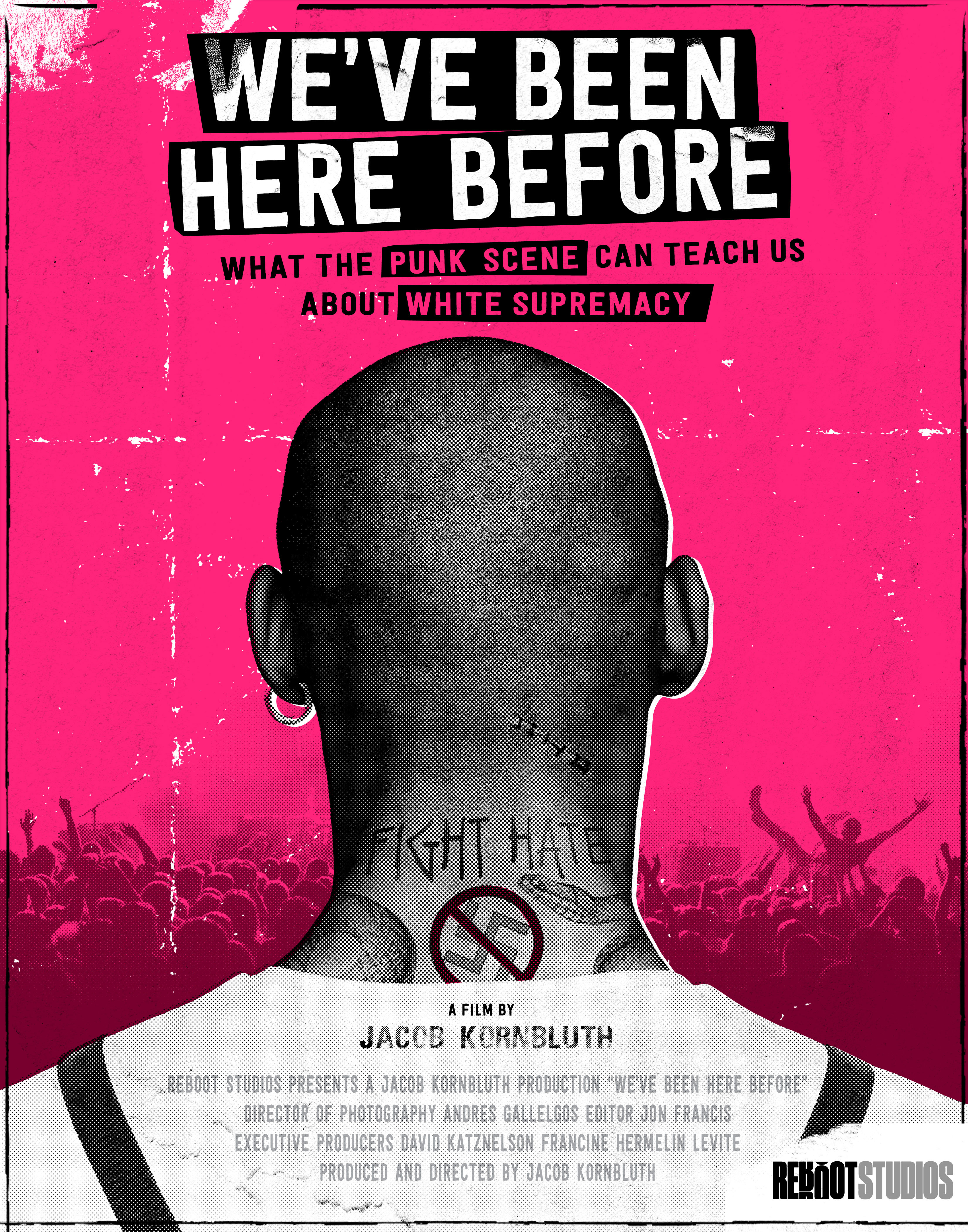
That story matters because it undercuts a comforting myth: that the only place to confront these ideologies is after they capture institutions. Sometimes the first real resistance happens in culture, in subcultures, in everyday spaces where people refuse to let intimidation become normal. People who read the signs early are rarely celebrated at the time. They are often mocked. Until the day they are proven right.
Holocaust Remembrance Day also asks us to notice another pattern that repeats across time. Antisemitism is not only a direct attack. It is also a wedge strategy.
It is a classic antisemitic maneuver disguised as friendship: use Jews as a buffer in someone else’s political, economic, social or cultural fight, then let Jews absorb resentment and blame when the backlash comes. It isolates Jews from potential allies and turns Jewish safety into a bargaining chip rather than a moral obligation.
Now the part that will make everyone uncomfortable, which is often the part we most need to say plainly. Too many of us continue to treat antisemitism as someone else’s issue, secondary or too complicated to name out loud, including inside movements and communities that pride themselves on moral clarity. That hesitation has costs.
Antisemitism matters first because it harms Jews, period. Jewish safety is not a metaphor and not a tool. At the same time, antisemitic conspiracism is also a solvent that dissolves democratic reasoning. It teaches the public to replace evidence with suspicion and accountability with scapegoating. Once that mental habit becomes normal, other communities become more vulnerable too, because conspiracies never stop with one target. They move to the next group that can be cast as a threat.
If more of us had taken this seriously a decade ago, perhaps we would not be living inside as many of these consequences today. That is not an I told you so. It is a reminder that prevention is always cheaper than repair, and courage is always cheaper than grief.
Today we say we remember. But remembrance is not an emotion. It is a discipline.
It is the discipline of refusing The Protocols 2.0, whether it shows up as coded talk of “globalists” or as “great replacement theory” panic dressed up as common sense. It is the discipline of seeing how antisemitism can be used to wedge communities apart, even while claiming to defend Jews. It is the discipline of recognizing that when this story becomes normal inside politics, policy will follow, and real people die, not as symbols, as names.
Renee Good. Alex Pretti. Not a headline. Not collateral. Names.
If you want to honor the victims of the Holocaust today, start by defending the truth that the Holocaust tried to erase. Jews are not a hidden hand, not a plot, not a problem to be solved. Jews are people. And when a society forgets that it does not only betray Jews. It betrays its own capacity to live free from fear.
Most of all. Listen for the moment the Trump administration and its henchmen try to make the Great Replacement Theory, and its outcomes sound reasonable once more. That moment will be the door opening once more. The moment after will be whether we finally choose to close it.
Thank you so much for providing education around anti-semetic tropes ! None of this happens in a vacuum and that is why all of us must stand against prejudice in any form! 🙏❤️✨️