The Left Makes an Exception for "The Jews"
Why universal principles suddenly become negotiable when the subject turns to Zionism, Israel, and antisemitism

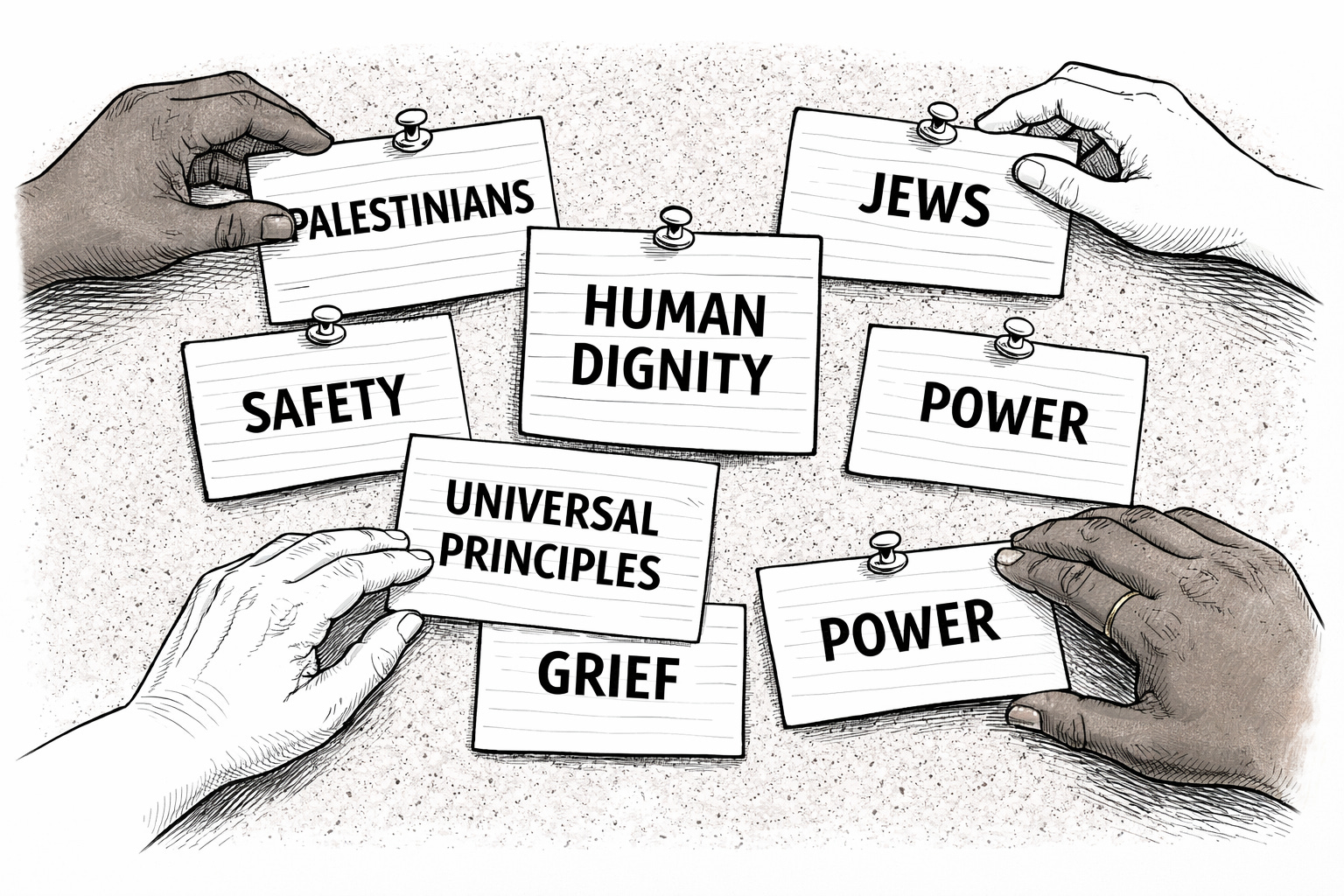
Author’s Note: This essay is not a defense of any government nor a dismissal of Palestinian suffering. It seeks to answer how movements committed to left politics can oppose injustice without resorting to collective blame or dehumanization. Nothing in this argument asks Palestinians, or those advocating for them, to be less grieved, less outraged, or less clear about state violence. Power and history matter, but principles lose meaning when applied selectively. Defending Jews from prejudice does not silence advocacy for Palestinians, just as advocating for Palestinians does not require minimizing threats to Jews. I do not offer a geopolitical solution. I ask whether solidarity can remain credible if its standards are not universal.
A thoughtful recent critique of my recent essay asked a set of difficult questions. If some Jewish people feel hurt by rhetoric like “from the river to the sea,” should it matter when Palestinians are facing dispossession and mass violence? Do concerns about antisemitism simply result in the protection of the misuse of Israeli power? Why does what is seen as legitimate criticism of Zionism as a concept get defined as antisemitic hostility toward Jews? These questions deserve engagement. They reflect real frustrations on the political left and a genuine desire to confront injustice.
I would contend that the issue is not whether Israel can be criticized. It can and must be. All nations should be held accountable for violations of international human rights norms, standards and practices, including Israel. And. I also believe that in the real urgency to confront injustice in Israeli policies and practices, we have abandoned some of the very principles that make anti-racist and left movements in the U.S. credible in the first place. In our stubborn refusal to seriously address whether moral outrage can remain morally serious if it makes exceptions to the rules, our movements for justice and liberation have lost our footing. The fact that many will be unable to read any further into this essay than this paragraph, underscores my point. For those still with me here, let’s turn to the example of rhetoric.
The phrase “from the river to the sea” illustrates how language can carry radically different meanings for different audiences. For many Palestinians it expresses a demand for freedom, equality, and an end to occupation across lands reserved for a Palestinian state between the Jordan River and the Mediterranean Sea. For many Jews, however, it echoes earlier and present political programs and militant rhetoric seeking a region without Israel and, by implication, without Jewish sovereignty. Because Jewish history around the world includes repeated episodes in which calls for expulsion or elimination preceded real violence, the phrase is often heard not as a metaphor for liberation but as a threat to collective survival.
I want to be clear on a point that often gets lost because of unconscious antisemitism. Jewish communities are not politically uniform, and neither are their responses to Gaza, the West Bank or the current U.S./Israel’s conflict with Iran and its non-state actors. Zionist, anti-Zionist, and non-Zionist Jews often disagree sharply, including over language, state power, history, and responsibility and not just between communities but within them as well. But significant and hotly contested political difference inside Jewish life do not erase the reality that rhetoric can still land on many Jews as threat, exclusion, or warning of mass violence.
Left movements committed to anti-racism, anti-imperialism and universal dignity do not need to first establish malicious intent to recognize that rhetoric can produce fear even when speakers intend something else. While this far from settles the meaning of the phrase for everyone, including myself, the example does make clear why dismissing Jewish concern about it outright is neither politically serious nor morally generous.
Criticism of Israeli government policy is legitimate and necessary. Israelis themselves debate it fiercely. Jewish communities across the world do as well. But when criticism slides into claims that most Jews are complicit in genocide, or fear is quickly dismissed that rhetoric like “global intifada” or “from the river to the sea” could lead to violence and ostracization for nothing more than their Jewish collective identity, something else is happening. Language has stopped describing and opposing state power and has begun to assign collective moral guilt to a people.
In this. Liberatory and anti-racist principles are not complicated. We do not hold entire peoples responsible for the actions of states. We do not collapse identities into governments. We do not treat intentional or unconscious prejudice as acceptable when it targets a group we associate with power. Yet when it comes to Jews, it seems too often that many on the left want to bend this rule. That alarms me as someone committed to anti-racism. My point is not that Jews deserve a unique exemption from political critique. It is that Jews should not be the exception to anti-racist principles.
Historically, antisemitism has always operated through the mechanism of conflation. Jews are imagined not as individuals with political diversity but as a unified force responsible for global harm. Their differences disappear. Their internal dissent becomes irrelevant. They are treated not as citizens or communities but as a problem. The irony is that much of the left would immediately recognize this logic if applied elsewhere. Most within the left would never say that Americans collectively “commit” every crime carried out by the U.S. government. We would never claim that Chinese people collectively share responsibility for the repression of Uyghurs. We rightfully continue reject Trumpism assertion that Muslims are collectively responsible for the crimes of extremist groups in their name.
Even in global conflicts where atrocities carry clear ethnic dimensions, we understand the danger of flattening complex violence into collective blame. In Sudan, armed militias have carried out devastating attacks, mass murders and sexual assaults against specific Black ethnic communities, prolonging a brutal civil war and humanitarian catastrophe. Yet most of us instinctively reject the idea that all Arabs or Muslims in Sudan or globally should bear collective guilt for those crimes. We recognize the difference between militias, governments, and entire peoples.
In short. We know how to make these distinctions when we choose to.
The question I wrestle with is why that moral clarity so often disappears when the subject turns to Jews. Some argue this shift is justified because Zionism itself is inherently racist. That argument deserves debate. Political and identity movements and state ideologies should always be open to criticism. But. Even if one reaches that conclusion, it still does not follow that Jews as a people become morally culpable for the actions of a state or the hijacking of a political ideology or belief. Anti-Zionism is not, by definition, antisemitism. But anti-Zionism does not become exempt from antisemitism either. Just like any political tendencies, anti-Zionist critiques can be expressed in ways that are principled and precise, or in ways that traffic in collective blame, erasure, and hostility toward Jews as Jews.
Our anti-racist principles should not disappear simply because many members of a community may support a particular project or government. We do not assign collective guilt to Native Americans for U.S. wars because a disproportionate percentage join the military, or to Muslims for governments or non-state actors acting in their name. The same standard must apply here. We have seen the opposite illiberal logic applied elsewhere with horrific consequence. In the United States, people of Chinese descent have often been treated as suspect because of presumed ties to the Chinese state, as if shared ethnicity or cultural connection were the same as political loyalty. It was wrong there too. Shared identity is not shared guilt.
Israel is not unique in being a state that centers a particular people, religion, or national identity. Many states do that. What makes Israel feel singular to many people is not the mere fact of a Jewish state, but the unresolved conflict around its creation, the continuing struggle over Palestinian dispossession and equality, and the tendency of some critics to treat Jewish national self-determination as uniquely illegitimate in a world full of states shaped by conquest, partition, empire, religion, or ethnonational identity.
The fact that many Jewish institutions, organizations, or individuals have ties to Israel does not make Jews everywhere fair targets for suspicion, blame, or inherited political responsibility. We should know better than to treat broad communities as politically suspect because institutions, leaders, or organizations within them have ties to a state or ideological project. We rightly reject that logic when Muslims were cast under suspicion because of proximity to the Muslim Brotherhood, and we should reject it here as well. Shared identity is not the same as shared guilt.
Advocates of Palestinian rights often emphasize the stark imbalance of power between Israel and the Palestinians: a sovereign state with a powerful military confronting a stateless population living under occupation, blockade, or displacement. That asymmetry is real and morally significant. Power shapes responsibility, and stronger actors bear greater obligations under international law and basic ethical reasoning. Yet recognizing unequal power does not eliminate the duty to avoid collective blame or dehumanization. Anti-racist principles were developed precisely for situations of conflict and domination, not only for moments of symmetry. If those principles apply only when groups possess equal power, they cease to be universal standards and become tactical tools.
I also recognize that the colonial frame is important to how many on the political left understand this conflict, and Palestinian experience of dispossession and mass violence and death is real and unacceptable. This can’t be said enough. But even here, the moral analysis in our rhetoric often becomes selective. Israel is hardly the only state in the Middle East, or the world, whose modern form was shaped by imperial collapse, outside powers, partition, war, or borders drawn without the consent of everyone who lived inside them. Much of the modern state system carries those marks, including the United States and the unceded indigenous lands we currently reside on. What makes Gaza and the West Bank morally urgent is not that Israel alone has contested origins, but that the conflict remains unresolved and continues to produce dispossession, mass deaths, fear, and competing claims to safety, land, and legitimacy. This last point is often lost and what often fills the gap is the slippery slope from legitimate criticisms of Zionism and Israel to outright antisemitism.
In truth. Nearly ten years after my essay, Skin In The Game. The response by the U.S. political left to its own antisemitism has not led to honest self-assessment and correction but rather accusations of antisemitism directed towards us are nothing more than an attempt silence criticism of Israel. I do think it important to acknowledge that there is truth in the concern that some powerful institutions and voices attempt to do just that — silence legitimate criticisms of Israel with accusations of antisemitic prejudice. It has happened and has been document in many contexts. The Nexus Project is one organization committed to confronting and documenting unfair and unprincipled charges of antisemitism. In full disclosure, I participate on an advisory panel to the organization.
But recognizing misuse does not justify dismissing the problem of antisemitism and its impact entirely. Antisemitism is real. It has risen sharply in the United States and globally and not just at the hands of white nationalists.
Jewish institutions, synagogues, and community centers increasingly face threats and violence from those who claim proximity to liberation movements and the political left. These attacks, including murders are not abstract debates about Zionism. They have consistently target Jews and Jewish business and institutions simply for being Jewish. When anti-racist and anti-imperialist movements fail to acknowledge and unequivocally condemn this reality, we unintentionally create space for it to grow and in ways that serve to undermine and divide the very civil rights coalition needed to defend the marginalized and vulnerable right here in the United States.
The current war has only deepened the stakes. Even after a Gaza ceasefire took effect in October 2025, violence has continued, and in recent weeks with U.S. and Israeli strikes in Iran, regional fighting has expanded. Israel has also intensified operations in Lebanon in response to attacks by Hezbollah, driving mass displacement there. None of this makes collective blame more defensible. A movement that excuses antisemitism in the name of anti-imperialism will eventually devolve to excusing other forms of racism and bigotry as well. History is full of examples where noble causes became corrupted by the belief that the ends justified the means. The question for the left is not whether we stand with Palestinians or Israelis. The question is whether we can defend universal principles while doing so.
History does not show that movements inevitably become bigoted when they abandon universal standards, but it does show that the erosion of principle rarely stops with a single exception. When conscious and unconscious prejudice is tolerated because it serves a perceived moral cause, the boundary between justice and expediency begins to blur. Twentieth-century politics offers repeated examples: revolutionary movements that promised liberation in Russia, Cambodia and China later justified repression and mass suffering as necessary for building a just society; anti-colonial struggles in places like Algeria produced regimes that silenced dissent in the name of national survival; and even democratic movements in India tolerated discrimination and violence against Sikh and Muslim minority groups once those groups were framed as collaborators or obstacles. The lesson I’m trying to draw here is not that today’s activists are destined to repeat those failures, but that no movement is immune to them. The warning is not that every left or liberatory movement will end in atrocity. It is that once dehumanization becomes perm
issible, moral restraint becomes harder to recover. Moral credibility depends on refusing to excuse dehumanization even when directed at those seen as powerful or complicit.
As I have tried to argue consistently over the last decade. The moral strength and credibility of the Black radical tradition have always come from refusing to abandon this principle even when it is inconvenient or complicated. We defend the humanity of everyone because the alternative is a world where human dignity becomes conditional, particularly for Black Americans and indigenous populations. This is why rhetoric matters. Language that erases entire peoples, romanticizes violence even unintentionally, or justifies civilian suffering as politically useful does not advance liberation. It corrodes the moral foundation needed to achieve and more importantly, sustain it.
None of what I have argued above requires ignoring Palestinian suffering. Quite the opposite. Palestinian civilians deserve safety, dignity, and freedom. Israeli civilians deserve safety, dignity, and freedom too. A serious anti-imperialist theory grounded in anti-racist politics must be able to say both. If we cannot, as I said at the beginning of this essay, something in our politics has gone wrong.
The challenge before us is not choosing sides between two populations living through tragedy one in the very real present and the other within a long unending historical cycle. It is resisting the temptation to explain that tragedy through narratives and actions that blame entire peoples. Jews do not have to agree with Zionism, anti-Zionism, non-Zionism, statehood, nationalism, or the future of the region to reject being cast, collectively, as suspect, disposable, or morally stained. When our movements insist that Jews must accept what is being cast, we have stopped fighting racism in my opinion and have instead adopted it. And when that happens, we lose something far more valuable than a political argument. We lose the very moral credibility that make U.S. based solidarity movements possible in the first place.
If the U.S. anti-imperialist and anti-racist left cannot come into its own maturity and confront this layered reality within our own ranks and with the same clarity we demand on issues and priorities we care about, we are no longer defending universal human dignity. We are negotiating with it. And real justice, self-determination and reconciliation have never survived that bargain.
I mostly agree with what you have said here! :) This is why it is important to be clear with language. Zionist is not the same as Jewish. There are Zionists of many religions, races and ethnicities. But the term also obscures its method. The only way to have a Jewish only state in Palestine is via the crimes against humanity of apartheid, ethnic cleansing and genocide. Therefore, support for Zionism or claims of being a Zionist makes one complicit with the crimes of the state to the varying degree of the power and influence one may have.
Interestingly, it was the same year that that UN was formed and the concept of international human rights law was fully birthed that Israel was created as a state. By international law Palestinians have a right of return. In many ways the state of "Israel" is not the question. The question is how that state is constituted.
The majority of Jews still do support the existence of Israel as a Jewish state -- although that number is declining in Jewish youth. Surely, not all Jews support the existence of a Jewish state -- many are the most vocally opposed -- and that is important. However, the crimes against humanity of genocide, ethnic cleansing and apartheid are crimes committed by states or "peoples" against other peoples. It's group on group. This is distinct from antisemitism, which is committed against individuals by other individuals.
Too often -- and you raise this in your article -- the charge of antisemitism is linked to anti-Zionism. Explicitly, Zionism is a form of racism because it necessitates apartheid and ethnic cleansing. In other words and interestingly the issue is the consequences, which is along the lines of what you stated as problematic in your other recent article -- in other words if the consequences attack a group then we need to look at the root. I agree with that. We need to constantly ensure that we are aligning with our true values -- and that we are not making exceptions or falling into inconsistency.
The argument that many other states were conceived as identity based, importantly including the United States, is weakened by the timing of Israel's creation. In the modern world we do not accept states constituted based on dominant identity -- importantly Jews are actually not numerically dominant in Israel/Palestine, which is the reason for preventing the right of return, bringing in specifically white presenting settlers and "mowing the lawn."
This argument I feel is also weakened by our own desires, as Black people, here in the United States, where we would find it unacceptable that the US continue to constitute and view itself as a white country. Why? Because that conception necessitates apartheid (formal or informal) and other structural means to maintain the dominance of whites. Until recently, we viewed our struggle here primarily through the framework of rights. As the system has continued to morph and reconstitute itself via white supremacy, our struggle is shifting toward liberation. And that is because of our inability to accept our structural conditions here -- because they violate our humanity.
So, I am pushing back on the idea that it would be acceptable for a state, forming itself as a state -- or a people forming themselves as a state -- in the modern world to base that formation on any aspect of identity. International human rights law rejects this idea holistically. A state is an abstraction that results from a people's self understanding of themselves as a people with a right to self-determination. This is where it gets sticky. But the principle is simple: a group cannot gain self determination at the expense of another group's self determination. The two groups must live alongside one another.
And here we come back to "from the river to the sea," which was originally a Zionist call for Greater Israel that was actually repurposed as a call for one democratic state. Hamas, which has a legal right to armed resistance unlike the occupying state of Israel, did use this phrase, which is where the idea or it being a call for annihilation stems from. However, Hamas revised their charter, and it could be due to white supremacy and Islamophobia that they are misunderstood.
I want to reiterate my point that even if our Jewish friends do support Zionism, we do not need to berate them with anger or worse yet hate. As humans we have the ability to recognize our own humanity in other humans, no matter how misguided we feel they may be. I reserve the right to simultaneously reject and repudiate Zionism and also to reject and repudiate hate being thrown at any fellow humans -- even those who support Zionism.
Eric, thank you so much for these important articles. I really deeply appreciate the opportunity to engage with you and grapple with these incredibly important issues and social dynamics. I hope that we can have more discussion like this. Thank you for your work.
You have crafted a beautifully written, thoughtful essay that reflects my views. It is painful to live in the reality of being Jewish in America, where one is constantly under threat of attack while witnessing the unremitting violence against Palestinians in Gaza and the West Bank. I have never forgotten being called Dirty Jew and Christ Killer as a child in elementary school, and I had hoped those days were long over. Thank you for having the courage to write this, Eric.